
by Elizabeth Hines | Oct 3, 2018 | Blog, Content Marketing, Data/Analytics, Logistics, Marketing, Social Media, Supply Chain
Use these three steps to calculate your social media ROI and prove the value of your investment.
As supply chain and logistics businesses are finally recognizing the merits of content marketing, and more specifically social media platforms, many are looking into implementing a program at their companies. But it doesn’t take much research to realize what an enormous investment it is. And how difficult it can be to prove social media ROI.
We understand the time and money it takes to successfully implement and manage a social media strategy as a part of your content marketing plan. Many companies we talk to need help convincing management that it’s a worthwhile investment. To that we say, use data!
But what data should you use? How do you quantify certain benefits, like growth in brand awareness? And do you really have to keep track of all the hours you spend managing social media, crafting new tweets, etc.?
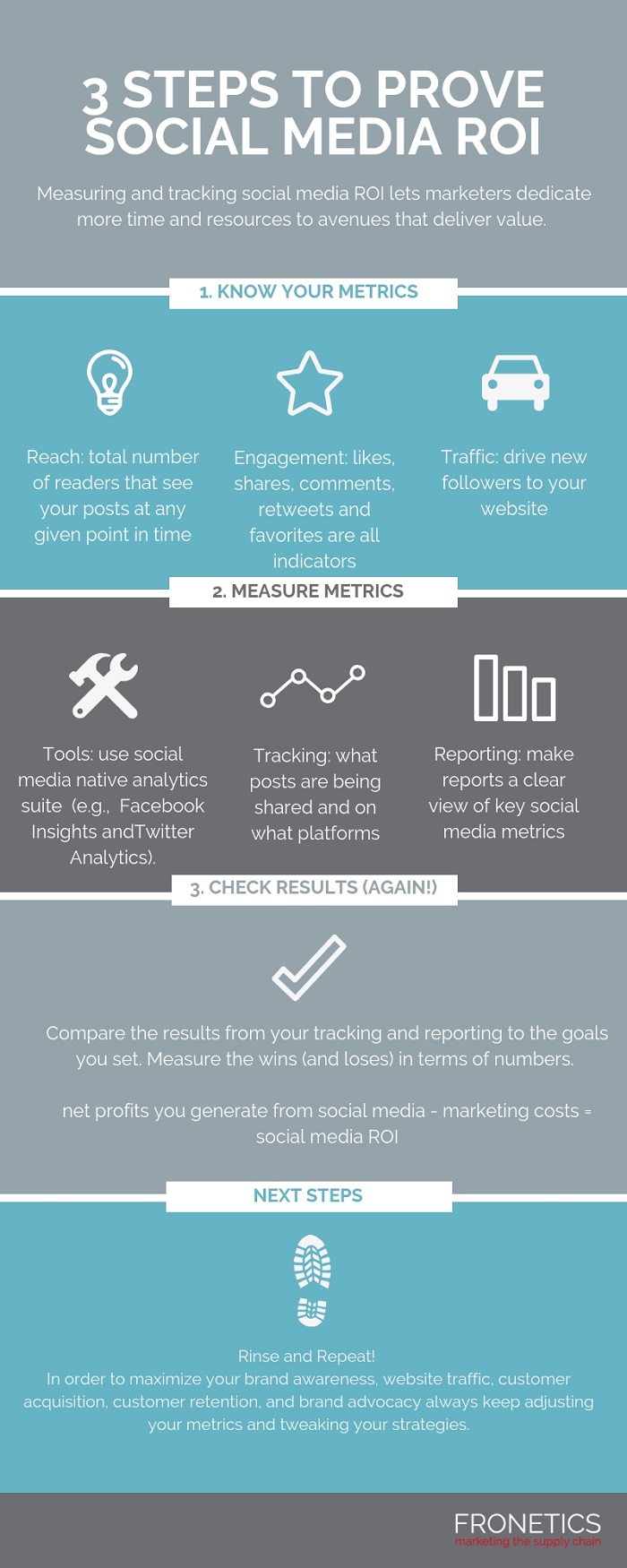
Here are three simple steps to start proving your social media ROI.
Infographic: 3 steps to prove social media ROI
(Made with Canva)
Final thoughts
Once you’ve calculated ROI for your social media platforms, it’s time to think strategically about optimizing your content marketing resources in terms of allocation and timing. Having hard data helps you answer questions about which initiatives are most fruitful, what language engages your audience best, when your efforts are most likely to pay off.
Ultimately, this data-driven approach lets you continually adapt to the needs of your audience, ensuring an ongoing, robust ROI.
Have you had to prove your social media ROI? What strategies did you use?
Related posts:


by Elizabeth Hines | Oct 2, 2018 | Blog, Content Marketing, Leadership, Manufacturing & Distribution, Marketing, Strategy, Supply Chain
Infographics are a content powerhouse, but creating them isn’t always easy. These five tips will help you make the most of this format.
Infographics can be one of the most effective content mediums. We know that digital natives, who make up the majority of B2B buyers today, prefer short-form, highly visual content. So infographics make a lot of sense when it comes to speaking their language.
Infographics are also prime candidates for reposts on social media. But, if you’ve ever tried to create one yourself, you know making an effective infographic is a lot harder than it sounds.
It might seem daunting at first, but these five tips will go a long way to help you in creating infographics that are effective in engaging supply chain buyers.
5 tips for creating infographics that engage supply chain buyers
1. It’s all about the title
Well, maybe not all, but your title does matter a lot. When it comes to infographics, your audience will definitely be judging a book by its cover. This means that your title should be accurate, short (70 characters or less), descriptive, and engaging. This is how your audience will decide whether they’ll click and read.
2. Colors matter
You’d be surprised by how much people are influenced by color in their content choices. The color scheme you choose should make your readers feel comfortable and should be visually appealing. This generally means sticking to two main colors and using no more than four colors. Use clear, bold colors for your main colors, and subtle, warm tones for complimentary colors.
3. Bump up your SEO
There aren’t a lot of downsides to infographics, but, unfortunately, there is one: publishing them on your blog doesn’t do much for your SEO, since text in infographics is contained in the image and isn’t recognized by search bots. But there’s an easy way around this: Include a transcript of your text with your graphic. I recommend writing at least 350 words, in addition to the graphic, to boost SEO.
4. Keep it simple
There’s a reason that simplicity is king when it comes to graphic design online. Increasingly, designers and businesses are favoring clean, minimalistic layouts. This means few unnecessary elements and plenty of white space so as not to overwhelm readers and to convey information without unnecessary distractions.
5. Get interactive!
If you’ve mastered creating infographics and are feeling ambitious, try taking on the next big thing: interactive designs. This means your readers can engage with your content, whether by hovering over it, clicking on it, or even answering questions or taking a quiz.
There are a number of infographic-creation tools available on the internet these days. At Fronetics, we really like using Canva, which has plenty of templates that are easy to use and do a lot of the design work for you.
What are your tips for creating infographics?
Related posts:


by Elizabeth Hines | Oct 1, 2018 | Blog, Content Marketing, Current Events, Logistics, Marketing, Strategy, Supply Chain, Talent
Considering instituting a work from home policy for your business? Ask yourself these three questions first.
As the supply chain becomes increasingly digital, many employers may be considering implementing a work from home policy. After all, we know one way to attract millennial talent is to allow for this kind of flexibility.
But before you make the decision to open the door to a work from home arrangement, consider these three questions.
3 questions to ask before implementing a work from home policy
1. Are your employees organized and self-motivated?
Ask any employee who works remotely, and they’re very likely to tell you that working from home makes them happier and more productive. And they aren’t necessarily wrong. There’s certainly evidence to suggest that with today’s technology, there’s essentially no downside to working from home, and it does often enhance productivity.
But working from home isn’t for everyone. Writing for the Harvard Business Review, marketing strategist and Duke University Professor Dorrie Clark suggests that workers considering a work-from-home arrangement first take a moment to introspect and understand how they work best.
According to author Natalie Sisson, “If you’re good at managing your own time, and you’re productive and have discipline, you’ll be able to do work from anywhere. But if you need to be in one place, and you need to go into an office, or need to be surrounded by the same people all the time, it probably won’t work for you.”
2. Is there a wealth of local talent?
One of the less-often-considered factors when businesses consider remote work arrangements is actually an important potential benefit for employers. Not every location has a tremendous amount of local talent, but that doesn’t have to limit your business. If you’re in an area where finding qualified employees is a challenge, making remote options available can be a big resource — essentially, the world is your oyster!
Consider having remote hires come onsite for training, team-building, or orientation, and make sure they’re equipped to meet the requirements of their positions. Once that initial foundation is laid, and expectations are clear, they can work from anywhere in the world — and save you the office space.
3. How much collaboration is required?
Are you considering remote work options for positions that require extensive collaboration with other employees? If so, it’s not necessarily a deal-breaker, but it does require some additional forethought.
With the technology available today, remote collaboration should theoretically be a piece of cake. But it’s important that everyone be on the same page about expectations. If remote workers are needed in a scheduled daily meeting, for example, it’s important that that expectation be made clear from the outset.
It’s also crucial to make sure that remote workers are given the resources they need to collaborate with their colleagues, and that they have a good understanding of the technology they’ll be using.
Work from home arrangements can be beneficial for employees and employers alike. But it’s important to consider all the variables to ensure that it’s the right thing for your business.
Related posts:


by Jennifer Hart Yim | Sep 26, 2018 | Blog, Content Marketing, Leadership, Logistics, Marketing, Supply Chain, Talent
In today’s job market, candidates are in such high demand, companies are posting positions with little or no experience requirements.
This guest post comes to us from Argentus Supply Chain Recruiting, a boutique recruitment firm specializing in Supply Chain Management and Procurement.
On the Argentus blog, we’ve spent the past few months charting the strong job market and its effects on hiring. My, how things have changed. A few short years ago, publications were writing about how employers weren’t bothering to hire for their open positions. Now, candidates are in such high demand, companies are more and more doing something that would be considered radical in the previous economy: posting positions with no experience requirements.
Kelsey Gee at the Wall Street Journal gave some frontline reporting about the talent picture in the U.S. economy, which is beginning to see strong wage growth follow historically low unemployment rates. She charts how more companies are becoming flexible in their hiring process, to the point of doing away with experience requirements for some positions completely. We’ve written before to argue that companies should hire people for their potential – especially junior employees – and in this market it seems that more companies are putting this into practice. Companies like Microsoft, Bank of America and Github, are in particular relaxing education requirements and looking at candidates who don’t have degrees for positions that would have required a degree during the recession.
Alicia Modestino, an economist at Northeastern University, has argued that in times of recession companies tend to raise job requirements, like in 2008. In times of expansion – like we’re seeing now – companies become more flexible in their requirements to compete for talent, a practice Modestino calls “Down-skilling.”
At first, it might be easy to assume that companies are only doing this for transactional or administrative positions, but the Wall Street Journal interviewed the President of SCM talent group – a Supply Chain Recruitment firm in the U.S. – who said that companies are re-evaluating their requirements for Supply Chain Managers and other strategic positions. He said that his recruitment firm has been turning away clients who want to fish for underpaid or unaware applicants instead of bolstering education, experience and compensation levels in order to compete.
At Argentus, we’re working in the same vertical in Canada. Candidates in our market are in such high demand that we’ve been doing the same.
Anecdotally, we’ve seen a small uptick in roles for high-potential entry level grads in Supply Chain Management – (though still not as many as we’d like to see, with the high number of new grads that come to us!) Companies are becoming slightly more willing to relax requirements on the junior end to hire quickly; in a hiring market as strong as this one, “entry level” can actually mean entry level instead of, paradoxically, requiring at least 3 years of experience. But companies should be more flexible, at least if they want to actually hire instead of kicking tires.
In strong job markets, companies can’t afford to hire the same way they did during a recession. More employees in Procurement and Supply Chain are waking up to their own value, and the strong job market is compounding an already-considerable talent crunch. Hiring managers can’t afford to practice magical thinking in their hiring in this economy – the type of thinking that says, “if we post it, they will come,” or that treats employees like they have no leverage in the process.
The WSJ outlined three options that companies have to keep down hiring costs and secure talent in this market:
- Offer more money up front
- Retrain current staff to upskill them for changing requirements, or:
- Become more flexible in their job requirements.
All three are valuable options, but for some reason the third one has always been a bit of a third rail. Hiring is a risk, and companies don’t want to hire someone who can’t do the job. But just because someone hasn’t done the exact same thing before, or just because they don’t have a degree, or just because they’ve done it before, but in another country, doesn’t mean they can’t do it.
There will always be lots of positions with considerable requirements that can’t be flexed away: a Director of Vendor management who’s conducting a business transformation obviously needs to have done that in the past. A Senior Manager tasked with setting up a totally new Supply Chain needs the deep base of knowledge and connections that certain experience provides. The necessity of strong experience and education requirements makes sense for some positions.
But for a Supply Chain Analyst, or a Buyer role, companies are well-served to relax hard-and-fast requirements and treat applicants on a case by case basis. Assess skills, assess technical and analytical capability, without requiring that candidates fit a specific experiential profile.
In our interviews with senior Supply Chain and Procurement leadership, one thing we hear again and again is that strong business acumen and soft skills – in other words, potential – is more important for junior employees than specific education requirements. So if the Wall Street Journal report is accurate, and more companies are waking up to this line of thinking, you know what?
Bring it on.
Related posts:

by Elizabeth Hines | Sep 25, 2018 | Blog, Content Marketing, Logistics, Marketing, Strategy, Supply Chain
Armed with high-quality, substantive content, sales teams can use inbound marketing to close deals and boost sales. Here’s the content they need to advance purchasing decisions.
Aligning sales and marketing teams is not a new concept, but one that many companies don’t follow. Think about it: the ultimate goal in business is increased revenue from sales growth! In order to achieve this goal, it’s best to focus on what the buyers’ needs are at the individual stages of the buying process and to provide content to help them move along the sales funnel.
You’re asking yourself, “How do I do that?” Easy, start combining your sales and marketing efforts to maximize what each department does best. When done correctly, content marketing can support sales goals, making it easier to generate leads and helping the sales team close business.
Valuable and relevant content is not a sales pitch but can help the sales process. Arm your sales team with content that communicates valuable information to prospects so that they have the knowledge to make more informed decisions.
Moreover, concentrate on creating the kinds of content your target audience seeks, and distribute it through the platforms on which they seek it. How-to videos on YouTube? Thought leadership on LinkedIn? Optimize the material you distribute for each channel and use your sales team to further distribute your content.
But what kinds of content does your sales team need in order to close deals? Here to discuss our top suggestions is Frank Cavallaro, CEO and Founder of Fronetics.
Video: what content sales needs in order to close deals
Takeaway: teamwork is key
Sales and marketing teams that are aligned perform better. According to State of Inbound 2018’s latest survey, sales teams closely aligned with their marketing counterparts ranked the quality of marketing-sourced leads much higher than those that were rarely aligned or misaligned. That shows that when marketing and sales work together, everyone gets more of what they’re looking for — namely, leads and sales!
Related posts:


by Elizabeth Hines | Sep 24, 2018 | Blog, Content Marketing, Current Events, Logistics, Marketing, Social Media, Strategy, Supply Chain
A new generation of buyers, digital natives, is shaking up the B2B purchasing landscape. Is your business ready to meet them online?
Digital natives, who now make up the majority of the B2B purchasing landscape, have completely changed how vendors need to market and sell to buyers.
In fact, according to a study of millennial buyers by Merit, some 73% of 20 to 35 year olds are involved in product or service purchase decision-making at their companies. Not only that, about half of all B2B product researchers are digital natives — and the number is rising by the year, according to a Google/Millward Brown digital survey of buyers.
It goes without saying that the B2B purchasing landscape is going through a radical shift. Here are 6 ways that digital natives have changed B2B purchasing — and how companies have to respond.
6 ways digital natives are changing B2B purchasing
1. Product searches begin with a generic web search.
This means that companies now have to focus on SEO and producing informative content. First impressions are everything in B2B markets, and when it comes to digital natives, your first impression is conveyed through every piece of content you produce and distribute online.
2. They bypass sales people.
So companies should aim to switch from primarily outbound marketing to inbound marketing. This doesn’t mean that salespeople are going to be out of jobs. But it does mean that sales and marketing need to work together in new ways.
3. Online search, vendors’ websites, and peer/colleague reviews are their most important sources of information.
It’s time to place focus on SEO, website development, social media, influencer marketing, and B2B review sites. Again, your reputation depends on your online content. Are you establishing your brand as a trusted source of information?
4. They prefer short bursts of information, often in visual formats.
Not only that, they find phone calls tedious and disruptive. Companies need to be strategic about the type and format of any content they distribute. Emails and websites should be mobile-friendly, and visual formats like infographics are a highly effective way to present dense information.
5. Social media is a preferred source.
These digital natives are relying on social media for information on brands, products, and services. How does your social media presence stack up?
6. They know what they want by the time a salesperson enters the process.
This new generation of buyers already has a clear idea of the value they expect from a vendor by the time they’re ready to move down the sales funnel. So vendors need to deliver on the promises made by their content.
How is your company accommodating the research and purchasing habits of digital natives?
Related posts: