by Elizabeth Hines | Jan 21, 2014 | Blog, Logistics, Strategy, Supply Chain
This post was originally published on EBN.
Summer is over, fall has arrived, and winter is right around the corner. As the days grow shorter and colder, don’t let inertia take over. Instead, put your packaging on a diet.
Here are three reasons why a packaging slim down will improve the health of your company’s supply chain and the world:
1. You can save money. By reducing the amount of packing you use for a product and/or by using right-size packaging, you can reduce transportation costs and materials costs.
For example, the packaging used for Apple’s iPhone 5 is 28 percent smaller than the packaging that was used for the original iPhone. The reduction in the size of the packaging translates into being able to fit 60 percent more iPhones on each shipping pallet. Apple points out that this saves the company one 747 flight for every 416,667 units they ship.
Poland Spring provides another example. Poland Spring has reduced the amount of resin that goes into the making of their bottles by a significant amount — from 14.6 grams of resin per bottle in 2005 to 9.2 grams of resin per bottle in 2012. Not only is the bottle 40 percent lighter (read: reduced transportation cost), the company also saves a sizeable amount of money each year in materials. In a recent Slate.com article Kim Jeffery, CEO of Nestle Waters North America (Poland Spring’s parent company), is quoted as saying:
You can’t be a public company and ask shareholders to bear the burden of higher costs just so you can be green. It has to be consistent with creating shareholder value. There needs to be a return on these investments. So, for example, when you use 200 million fewer pounds of resin a year, at 90 cents a pound, that’s a huge savings.
By my calculations, that’s a savings of $180 million annually.
2. It is better for the environment. Putting your packaging on a diet can reduce the amount of waste, CO2 emissions, deforestation, water use, water contamination, and hazardous material use.
In a September 2013 Packaging Digest article, Ron Sasine, senior director of packaging for private brands for Walmart, wrote that as a result of the company’s efforts to reduce packaging it was “able to reduce the overall greenhouse gas impact of our packaging by an average of 9.8 percent in our Walmart U.S. stores, 9.1 percent in our Sam’s Clubs in the U.S. and 16 percent in our Walmart Canada stores.”
3. It makes your customers happy. A 2012 survey conducted by Packaging World and DuPont Packaging & Industrial Polymers found that the primary focus of the packaging world over the next 10 years will shift from cost to sustainability. Specifically, the report found that 45 percent of those surveyed believe that perceived “greenness” will be important to consumers.
Additionally, a 2012 study released by Perception Research Services reported that in 2011 significantly more shoppers were more likely to choose environmentally friendly packaging than in 2010 (36 percent versus 28 percent), and that half of shoppers surveyed were willing to pay for environmentally friendly packaging.
Tell us your thoughts on packaging trends in the electronics industry. What’s important to you and your customers?
by Elizabeth Hines | Jan 7, 2014 | Blog, Leadership, Strategy, Talent
how to hire a leader
Businesses don’t fail, leaders do – a lot. Studies have shown that the rate of failure of executives coming into new companies ranges from 30 to 40 percent after 18 months. The costs and implications of a poor leadership hire are enormous. Given the odds, how can you hire a leader – a true leader? Here are five tips:
Ask the right question
Just one interview question can give you enormous insight into the abilities and qualifications of the candidate. The question: “Tell me about the last person you fired.” According to Marc Barros, co-founder and former CEO of Contour, this question and the discussion that will follow will give you the “strongest indicator of the candidate’s leadership ability.” Specifically, the candidate’s response will shed light on their communication style and skills, their willingness and ability to admit mistakes, and the candidate’s level of empathy and emotion.
Conduct your own due diligence
When it comes to finding the next leader for your company, don’t leave due diligence in the hands of someone else. Take the time to learn about the candidate, talk to people who have worked with the candidate in the past, and gather as much information on the person as you can.
Go beyond the typical interview
Going beyond the typical interview is revealing in that enables you to see the candidate outside of the canned interview environment (an environment which many have mastered). Some ideas: have the candidate give a presentation, facilitate a meeting, or write up their thoughts on how to tackle a specific problem.
Opinions matter
Have the candidate meet with employees of various positions and levels within the company. After each person meets with the candidate get their feedback – and listen. It is amazing how often a candidate will let their guard down when they perceive they are meeting with someone that “doesn’t matter.” The truth is that these meetings do matter as they can provide you with some of the best insight into the candidate and their leadership style.
Hire from inside
When you hire from inside your company, you will get a leader who knows how to succeed in the company’s culture.

by Elizabeth Hines | Dec 11, 2013 | Blog, Leadership, Strategy, Talent

Source: CrossFit Full Potential
CrossFitters recognize that good outcomes only come with hard work, and lots of it. For that reason, it generally attracts people who are willing to make sacrifices and go the extra mile to get results both in the gym and at work.
If you want to hire top performers who have staying power hire people who do CrossFit. Here are eight reasons why CrossFitters make great employees.
1. They are able to work with a variety of people
In business it is essential to be able to work with a variety of different people – people within different departments, at different levels within the company, even across various industries. However, many employees don’t have this capability and they fall flat. CrossFitters excel in this area. On a typical day a CrossFit class is comprised of people who have attended just one class and people who have been religiously attending CrossFit for several years, ex-Marines, pregnant women, people in their 20’s, and people in their 70s. There are people who have been athletes their whole life and people for whom CrossFit is their first foray into an active lifestyle. Because there are such a variety of people at CrossFit, when team or partner work comes into play it is essential to, seamlessly, be able to work with anyone and everyone.
2. They are willing to try new things
Business is ever evolving. In order to stay competitive it is essential that your business is willing to try new things, to be inventive, to be creative, and to be able to be willing to change. An employee who is unwilling to try new things becomes a barrier to change and to the evolution of your company. CrossFit is about trying new things and not getting bogged down with routine; CrossFitters train to be ready for the “unknown and unknowable.”
3. They are willing to go beyond their comfort zone
A step beyond trying new things is stepping outside of the comfort zone. Going beyond the comfort zone involves risk and can lead to failure. Because of this, many employees are unwilling to go beyond their comfort zone. However, employees who are willing to take this leap are typically those who bring creativity, drive, and innovation to the company. CrossFit encourages people to go beyond their comfort zone and, by nature, the majority of CrossFitters leap at this chance.
4. They can recognize their limits
Everyone has their limits. An employee who is able to recognize his or her limits is much more effective and efficient than an employee who cannot recognize their limits. If your employee knows the right time to ask for help your guidance you are lucky. CrossFitters are adept at knowing their limits; in CrossFit knowing your limits is essential in that going beyond can result in injury.
5. They are willing to tackle seemingly insurmountable problems
Many employees tackle the small problems and leave the big ones alone hoping someone else will take them on. Or, even worse, some employees are so focused on the small problems they don’t even notice that there are bigger problems which need to be addressed. Each workout of the day (WOD) presents seemingly insurmountable problems. That CrossFitters choose to do an activity which consistently presents participants with seemingly insurmountable problems tells you a lot about the drive of CrossFitters.
6. They like challenge
Employees who like to play it safe and easy are not going to be top performers. If you want top performers, look for employees who embrace challenge. CrossFitters embrace challenge. For example, a couple weeks ago the WOD was to, as a team of three, deadlift 25,000 pounds. My team was comprised of an ex-professional hockey player, a woman in her 30’s who was relatively new to CrossFit, and me (5’1” and not easily mistaken for the world’s strongest woman). Faced with a big challenge and a diverse team (see #1) – we dove in…headfirst.
7. They work hard
Dan Vadala, business consultant and owner of CrossFit Full Potential, describes the work ethic of CrossFitters: “CrossFitters recognize that good outcomes only come with hard work, and lots of it. For that reason, it generally attracts people who are willing to make sacrifices and go the extra mile to get results both in the gym and at work.” Moreover, Vadala notes that he sees positive transformations in those who do CrossFit: “CrossFit has the capacity to transform people into the types of performers and self-starters that employers are finding harder and harder to recruit.”
8. They are supportive
A good employee will support others through the good and the bad. A supportive employee will be the first to recognize their peers for a job well done, and be the first to provide guidance to those who appear to be struggling. A supportive employee is good for morale and good for your company. CrossFitters are a supportive bunch. I have never participated in another activity in which there has been so much support from so many people. “Nice work!”, and “Well done!” is heard over and over again as are little tidbits of information such as “That looks great, but if you try moving your grip a little you’ll be amazed by what you can do.”

by Elizabeth Hines | Dec 2, 2013 | Blog, Marketing, Social Media, Strategy
Not too long ago I did not use Twitter and I relished being able to say that I had never sent a Tweet. I believed Twitter was not applicable to me – I don’t follow celebrity gossip and whereabouts, I don’t like the idea of sharing my personal thoughts and experiences with 232 million strangers, and I have yet to take a “selfie” (much less share it with said 232 million strangers). In short, I didn’t use Twitter because I did not understand Twitter and I had no idea of its value. When I finally decided to remove my head from the sand and take stock of Twitter I was blown away not only by what Twitter really is, but also by my ignorance. Using Twitter for business is essential. If you and your business have not yet taken the plunge into the Twitter pool it is time to grab your trunks and jump.
A 2013 study conducted by the Center for Marketing Research at the University of Dartmouth found that 77 percent of Fortune 500 companies have an active corporate blog. The study also found that rank influences Twitter use – 43 percent of the Twitter accounts are held by companies in the top 200 on the list as compared with the bottom 200 which hold 43 percent of the Twitter accounts. Similarly, 67 percent of the Inc. 500 use Twitter. Looking at small businesses, in 2013 Constant Contact reported that 25 percent of small businesses use Twitter – up from only 7 percent last year.
Why is it important to know who is using Twitter? Because those who are using Twitter are more likely to gain customers than those who don’t. A survey conducted by Market Probe International found that 72 percent of those who follow a business on Twitter are more likely to make a purchase from that business and that 82 percent of followers are more likely to recommend a product or service to friends and family. The survey also found that 85 percent of respondents reported feeling a closer connection to a small business if they follow them on Twitter.
In addition to demand generation, the following are reasons why you and your business should use Twitter:
- Increase market intelligence
- Drive traffic to your website
- Monitor your business and your brand
- Connect with customers
- Manage risk
- Share information
Still skeptical?
SJF Material Handling Equipment is the single largest source for new, used and refurbished material handling equipment in the US. The company has built an extensive and successful social media network – one which uses Twitter – with the objective of increasing sales. The company has 55,797 followers on Twitter (and is gaining 200 to 400 followers each week). Stafford Sterner, President of SJF, says that Twitter enables the company to cover more ground and attract customers from unexpected and often unrelated circles.
Another example is the battle for customers between AT&T and T-Mobile that played out on Twitter. The throw down began when Jay Rooney Tweeted that he was considering a switch from AT&T to T-Mobile.
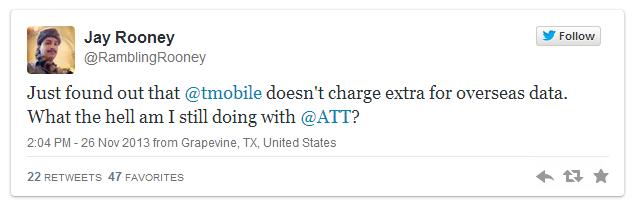
What occurred next was an all-out battle between AT&T and T-Mobile for Jay Rooney (and other customers) – both companies took to Twitter to try to convince Rooney that their company and service is the best. Rooney does a great job of summarizing the exchange:
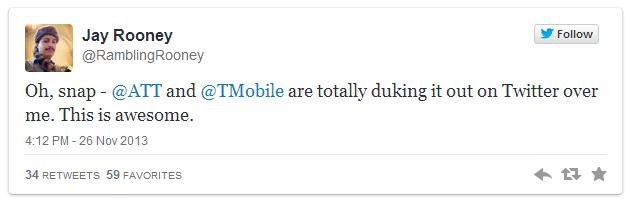
The battle for Rooney intensifies and T-Mobile’s Chief Executive John Legere jumps in the fray:

Impressed, Jay Rooney decides to make the jump to T-Mobile. What’s more, the conversation caught the attention of many others. In the end, the exchange netted customers for T-Mobile.
(For more on the exchange, check out ZDNet’s article on battle between AT&T and T-Mobile.)
Ready to take the plunge? Social Media Examiner has a great how to article on how to use Twitter for business and for marketing.

by Elizabeth Hines | Nov 19, 2013 | Blog, Leadership, Strategy, Talent
Career Builder identified Supply Chain Manager as a Top Growth Job for 2013. Why did supply chain manager make the short list (just 18 jobs made the list)? Supply chain manager has experienced an 8 percent job growth since 2010 and there is just one active candidate for every five posted jobs. Colleges and universities have recognized the demand – and opportunity. The Wall Street Journal recently reported that supply chain management is the “hot new MBA” and that “more than a half-dozen universities have recently introduced undergraduate majors, M.B.A. concentrations and even entire degree programs dedicated to procurement, inventory management and global supply-chain strategy.”
Finding the right person for a job opening is essential. Hiring the wrong person is a costly mistake not only financially, but also in terms of team morale and productivity. Given the demand for supply chain talent, the dearth of experienced talent, and an increasing number of newly graduated talent entering the job market – how do you find and hire the right person? Here are a few tips on how to hire.
Look across the industry
Look across the industry and identify individuals who are a good match to your company and the role.
Look within the company
Look inside your company. Is there someone who would thrive in a new role – even if the role is outside of their current field?
Look outside the industry
While this may seem counter intuitive, bringing in a talented professional from outside the industry could provide the fresh ideas and insight that your company.
Work with colleges and universities
Develop a relationship with colleges and universities. Work with the schools to identify upcoming or recent graduates who are/were stars. Another option is to establish an internship program with a school.
Work with a strategic advisory firm
Working with a strategic advisory firm is an option as well. This type of partnership, such as the ones I build with our clients, can make identifying the right talent for the right position easier. An advisory firm often has the pulse on where the most talented people are in the supply chain and logistics industry. This type of partner can launch a successful candidate search process, get new hires up and running, and help retain talent for the long run.
Be creative and have vision
Throughout the hiring process remember that creativity and vision are key.
Offer an out
Here is a great example of offering an out. Zappos pays new employees to quit. You read that right – the company pays new employees to quit their jobs. Once new employees have completed their 4 wee training program they are given “The Offer.” That is, they can choose to remain with the company or quit. If they choose to quit they will be paid for the time they worked and given an additional $3,000. The employee has 24 hours to decide. Why does the company do this? If the employee is not happy in the new position and not committed, it makes sense for both parties to cut and run.
