
by Elizabeth Hines | Sep 6, 2018 | Blog, Content Marketing, Current Events, Logistics, Marketing, Social Media, Strategy, Supply Chain
Digital natives are changing the landscape for B2B purchasing. Here’s what you need to know about the new B2B buyer.
Long gone are the days of men and women sitting around a conference table listening to a sales pitch over a free lunch. Today’s B2B buyers are younger, more technologically savvy, and more independent — they’re a generation of digital natives. And they’re making waves across the B2B buying landscape and changing how marketers must work to reach new customers.
Who are digital natives?
The term digital native describes a person that grows up in the digital age, rather than acquiring familiarity with digital systems as an adult. So, unlike the previous generation, digital natives grew up understanding how to work a computer and a mobile phone instead of picking up these skills (slowly) in our 20s, 30s, or even later.
Having grown up in a time of rapid technological advancement, digital natives are very comfortable online. These skills have carried over to their professional careers, as millennials descend upon the workforce. Organic searches have become the starting point for researching products and services, instead of looking for specific brands.
Ch-ch-changes
This new reality means marketers trying to reach new customers must make big changes in the way they target and engage today’s buyers. Marketers have had to shift their focus from outbound marketing to inbound tactics, like content marketing, to engage and connect with their target audiences.
Here’s what you need to know about digital natives and how their tech-savvy ways have changed the B2B purchasing process.
Infographic: How digital natives are changing B2B purchasing
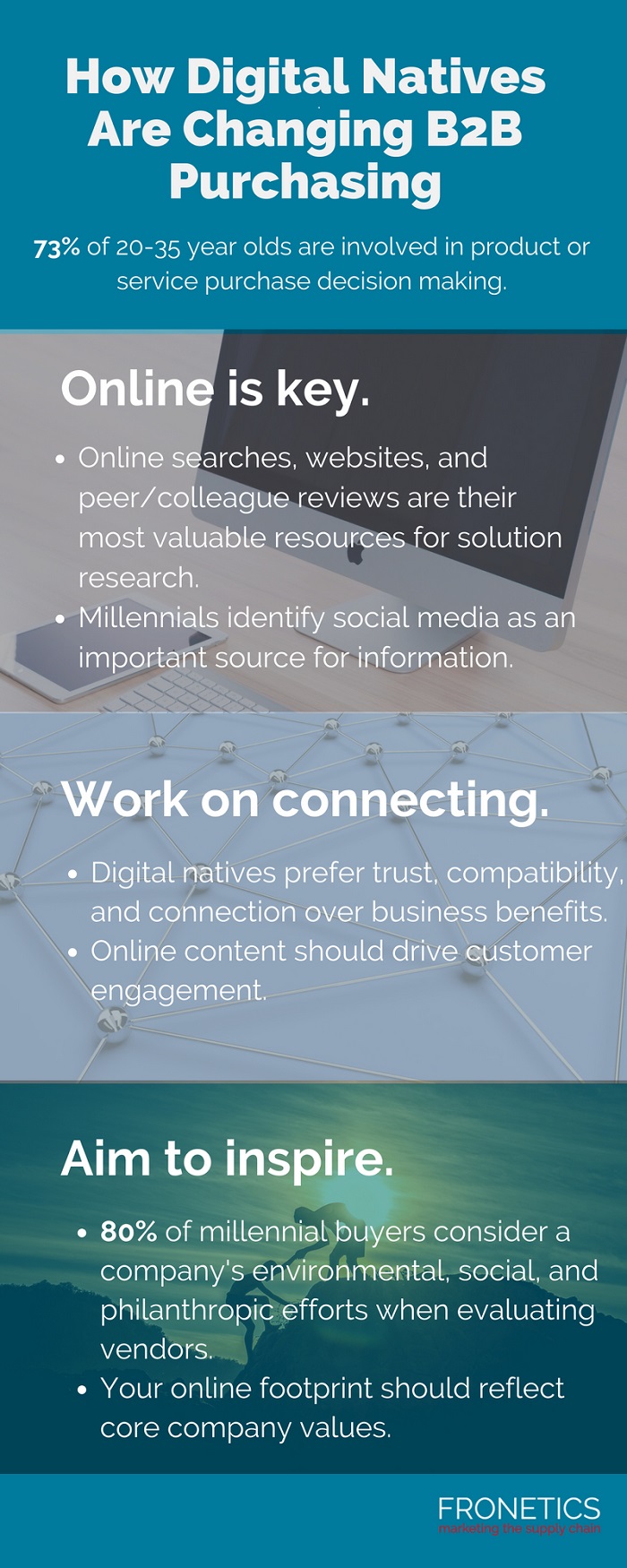
(Made with Canva)
Final thoughts
With so much content available on the internet, first impressions are everything. Your website needs to be informative and visually pleasing. Your social media posts need to be engaging. Your blog posts need to be enlightening. Make sure your online presence accurately depicts who you are as a brand and what you stand for. Digital natives will be more likely to find and connect with you.
Have digital natives had an impact on your business? Tell us about it.
Related posts:


by Elizabeth Hines | Dec 20, 2017 | Blog, Talent
Here are our most-viewed blog posts from 2017 about talent, including tips on retaining your top talent and helping turn your employees into brand ambassadors.
The start of the new year brings along a host of resolutions. Finding a new job or advancing in a current position are common new year’s resolutions for individuals. For companies, identifying new strengths and interests within your employees and hiring and retaining great talent are common goals.
We’ve assembled our top 10 talent posts of 2017. We hope these posts help you and/or your company overcome challenges, and achieve your goals for next year.
Top 10 most popular talent posts of 2017
1. Gender Diversity is Not a Women’s Issue: It’s an Economic Issue
Gender diversity is generally viewed as a women’s issue. It is not. Research conducted by McKinsey & Company and LeanIn.org finds that despite corporate America’s stated commitment to gender diversity, outcomes are not changing. Moreover, the research finds that employees do not believe companies are taking the necessary steps to enact change. Read more.
2. Top Supply Chain Management MBA Programs 2018
Looking for talent? Try recruiting from these top-rated supply chain management MBA programs and schools. We have written before about the importance of recruiting and strengthening the relationship between academia and the supply chain industry as means to solve the growing supply chain talent gap. If your company is looking to hire, consider strengthening your rapport with schools that offer supply chain programs or specialties. Read more.
3. Are We Thinking About “Soft Skills” All Wrong?
By calling them “soft skills,” are we shortchanging competencies that are critical for supply chain and procurement professionals to succeed? One of the biggest stories in the world of Supply Chain and Procurement talent over the past few years has been the emerging importance of Soft Skills. As the field has become more strategic — with a greater impact on wider areas of business — professionals in the field have had to become stronger at advocating for it. Read more.
4. Great Supply Chain People Are Getting Harder to Find, But Do Companies Have a Talent Management Issue?
Is the Supply Chain talent gap problem really a talent management problem? This guest post from Argentus explores the so-called “talent deficit” in the field from all angles and perspectives. The fact is, it’s becoming harder for companies for find the talent that they need for these positions as baby boomers retire and the function evolves. Read more.
5. Employee Brand Ambassadors Can Influence B2B Buying Decisions
As peer influence becomes increasingly important in B2B buying decisions, empowering employee brand ambassadors will benefit your bottom line. I’ve written lately about the rise of influencer marketing. It’s a strategy B2B businesses are starting to understand and use to their advantage. But you don’t need a Kardashian or even an important industry professional to get started. Employees are your most natural, ready-made influencers. Read more.
6. Freight Driver Shortage Update: Will 2017 Come to a Head and Cause Issues for Shippers?
Growing woes over a forthcoming capacity crunch are not going away anytime soon. But, the capacity crunch may have a major impact on the freight driver shortage and vice versa. In a sense, fewer drivers mean that capacity will grow tighter. Yet, as capacity shrinks, the incentive for drivers increases. Read more.
7. 3 Ways to Attract Millennial Talent for the Supply Chain
Hoping to draw more millennials to your talent pool? Implementing these three ideas might help win them over. By the year 2020, millennials are estimated to make up a majority of the workforce. In addition, a 2014 study found that 46% of B2B buyers were millennials, and that number is on the rise. This seismic shift in workplace demographics calls for a new approach to attracting and retaining talent. Read more.
8. 3 Questions to Ask before Making a Professional Change and Overcommitting
Thinking of making a professional change? Here are some questions to consider before taking the plunge and overcommitting. We’ve all been asked to take on new projects at work when we’re already completely swamped. In the moment, it can be very hard to say no. And we’ve all jumped on LinkedIn to see what other opportunities are out there. More money, less headaches. The grass is always greener. Read more.
9. Could Liberal Arts Grads Fill the Supply Chain Talent Gap?
Mark Cuban thinks liberal arts grads will be the next in-demand employees. Could they be the answer to the supply chain talent gap? The supply chain talent gap has been called a “perfect storm.” Every report cites doomsday statistics of the impending crisis when, by 2025, 60 million baby boomers will exit the workforce, leaving only 40 million millennials to take their place. Read more.
10. Three Tips for Retaining Your Top Talent
Investing in your top talent and playing an active role in developing their careers will motivate them to stay around. Company loyalty is a thing of the past. In today’s day and age, everyone is looking for the next best thing, and that is true in the workplace as well. But this doesn’t mean that retention of top talent is hopeless. Read more.
Related posts:


by Elizabeth Hines | Apr 3, 2017 | Blog, Logistics, Strategy, Supply Chain, Talent
Hoping to draw more millennials to your talent pool? Implementing these three ideas might help win them over.
By the year 2020, millennials are estimated to make up a majority of the workforce. In addition, a 2014 study found that 46% of B2B buyers were millennials, and that number is on the rise. This seismic shift in workplace demographics calls for a new approach to attracting and retaining talent.
There are all kinds of stereotypes about this up-and-coming generation, many with a basis in truth, and just as many without. It’s crucial for your business to get to know this demographic group, both in terms of how they behave as consumers, and how they operate in the workplace. To that end, here are some ideas for attracting this talent pool to your company.
3 ideas for attracting millennial talent
1) Green technologies
Millennials are a generation saddled with all kinds of debt — from student loans to the ecological damage done by previous generations. Studies, not to mention voting behaviors, have shown that this generation is avidly interested in improving the planet’s future.
To win the hearts and minds of millennials, it’s time for your business to consider “going green.” Of course, green technologies can be prohibitively costly on a large scale — but many small changes can save you money in the long run. Not to mention, they will make your business a more attractive place to work for eco-minded millennials.
Consider making the switch from conventional to LED light bulbs, for example. If you have the resources, coupling smart thermostats in your facilities with higher-efficiency windows and doors is a great way to improve your carbon footprint, as well as your credentials among younger employees. Whatever your capabilities, making an effort to go green will go a long way toward making your business attractive to this generation.
2) Work-from-home options
Millennials are digital natives, accustomed to technology at their fingertips, with all the options that opens up to them. This often means the expectation of being able to work from a location of their choosing, whether it be home, a library, or a coffee shop. Millennials rank this kind of flexibility highly among factors that make companies appealing places to work.
Employers are increasingly answering the call, and even massive corporations like Wells Fargo and Aetna are finding ways to allow employees the option to work from home. These employers are finding that, often, what sounds great for employees also works to their advantage: A change of location can freshen thoughts, increase creativity, and lessen burnout that can slow down work for a team or entire company.
3) Opportunities to learn
Millennials are highly educated, and thirsty for knowledge — left unquenched, this thirst can lead them to job-hop frequently. At any given moment, 60% of millennial workers are open to pursuing a new employment opportunity. So how does your business combat this tendency and reduce turnover? One place to start is by offering continuing education to your workforce.
There are all kinds of ways to do this, and all kinds of benefits — including benefits to your bottom line. Making your employees more well-rounded means that they are more likely to be creative and flexible, able to respond to the needs of the constantly evolving supply chain industry.
Relating to millennials
Here’s the open secret: While each generation might have its quirks, millennials aren’t really all that different at the core than previous generations. They may express it in different ways, but they essentially want what workers have always wanted: interesting work, the opportunity to better themselves regularly, and to be treated with respect and dignity.
At the end of the day, you don’t need to be overly concerned about “relating” to millennials. According to one millennial writer, Sarah Landrum, “Millennials are in tune with current events, interested in getting involved with charity, and more interested in the world outside their heads than you might suspect.”
Related posts:

by Elizabeth Hines | Apr 30, 2015 | Blog, Strategy, Supply Chain, Talent
Why “sexy” is a perfect fit for the supply chain.
Why do we apply the word “sexy” to things that are non-sexual, like, for example, the supply chain? Sexy is synonymous with the words exciting, appealing, fascinating, desirable, provocative. It’s a buzzword for something popular and attractive. When people think of the supply chain, do they think of the word “sexy”? Many might say no, but here’s an argument as to why it’s a perfect fit.
Are Apple products sexy? Are designer clothes sexy? Is the Audi A5 sexy? Are oysters sexy? Many people would answer yes. Substitute your favorite and most desired technology, clothes, cars, and food, and you will find that they are all products of the supply chain. Senior Vice President of Research at SCM World, Mark Davis, is leading the charge in pointing out the vibrancy, attractiveness, and desirability of the supply chain. A study conducted by SCM World shows how consumers view the supply chain. Here’s what they found:
- Very few people react to the supply chain in a negative or strongly negative way.
- People aged 16-25 view the supply chain as positive or strongly positive, which is more optimistic than any other age groups reported.
- People aged 56 and older reported the highest level of unfamiliarity with the supply chain, while people aged 16-25 reported being most familiar with the supply chain.
- People aged 16-25 were the least neutral compared to other ages in their reaction to the supply chain.
Given what we know about the Millennial generation, this makes sense, and it could be good news for the supply chain. Millennials are optimistic, achievement-oriented, social, collaborative, tech-savvy, and value-based. Their buying patterns are informing everything we do and it should be stressed that there are many of them. According to the New York Times, “there are more 23-year-olds — 4.7 million of them — than any other age, according to census data from June. The second most populous age group was 24, and the third was 22. There is no official age range for Millennials but the generation generally is defined as being born between the early 1980s and early 2000s. By 2020, they will account for one-third of the adult population.” We think of the Baby Boomer generation as the largest age group, but at 24% they are just surpassed by the Millennial generation at 26% of the population.
Often we equate what is sexy with youth. With the Millennial generation—our youth— poised to make up 50% of the workforce by 2020, the supply chain could harness their optimism and interest. According to Mark Davis, “we should all be highly optimistic about the future. Millennials are strongly positive about supply chain, which presents a unique opportunity for us to inspire them to choose it as a career. We have to keep them interested by sharing stories of how supply chain is innovating to solve the world’s three fundamental issues: health, hunger and environmental sustainability.”
Aside from being supported by Millennials, why else would we consider the supply chain “sexy”? Some of the most innovative work is being done in the supply chain, including enterprise resource planning, cloud-based computing, use of big data, and involvement in the Internet of Things. If the supply chain can continue to harness technology, make smart hires, and attract Millennials, the word “sexy” could apply for a long time.

by Elizabeth Hines | Jan 28, 2015 | Blog, Marketing, Social Media, Supply Chain, Talent

Strategies for attracting and retaining Millennials for the supply chain industry.
This is part one of two in a series examining the role of Millennials in the supply chain industry. Part one highlights strategies for attracting and retaining top Millennial talent.
For the college graduating class of 2015, Jimmy Carter has always been a smiling elderly man who shows up on TV to promote fair elections and disaster relief. Electric cars have always been humming in relative silence on the road. American tax forms have always been available in Spanish. There has always been an Internet ramp onto the information highway.
Since 1998 Beloit College has released its ‘Mindset List’, giving us a look at the “cultural touchstones that shape the lives of students entering college.” The List for this year’s graduating class represents a singular profile of students born in 1993 who are part of a larger, increasingly more influential generation – Millennials. With supply chain industry leaders lamenting a growing talent gap, tapping the Millennial generation may be key to filling that gap.
Who are Millennials?
To help us understand how to attract Millennials and why they could give new life to a graying profession, let’s examine who they are and what motivates them. Millennials, those born after 1981, are generally highly educated – though often saddled with debt and underemployed – digital natives who are decidedly collaborative by nature. They’re delaying marriage and parenthood and instead engaging in pursuits of higher education and travel, fueling their strong sense of optimism. Supply chain companies should be actively seeking to attract these Millennials and leverage their strengths to build a strong supply chain industry outlook.
Attracting Millennials
A growing number of university program offerings reflects a strengthening partnership between academia and the supply chain industry, a strategy many companies are relying on to attract and recruit top candidates. Joining existing programs and supporting the establishment of new programs, such as smaller supply chain certification programs, are effective ways to draw top talent. Further support of academic programs through joint curriculum building and offering internship opportunities help to build strong early relationships with students and will have a positive effect on recruitment efforts come graduation time.
Consider non-traditional channels to promote job openings. The frequent use of social media by Millennials has been well documented. Social media can be used to attract great supply chain talent. Furthermore, using social media for the promotion of job announcements establishes brand awareness and allows for more informal candidate engagement, something Millennials find particularly attractive. Similarly, creating visually appealing job descriptions will help to get more out of job postings.
Compensation plans should reflect motivations by which Millennials are incentivized. Different from their older counterparts, Millennials prioritize flexibility and work mobility over salary when considering a job offer. And, with total outstanding student loan debt topping $1 trillion in 2014, Millennials are favoring companies who offer tuition reimbursement programs.
On-Boarding and Retaining Millennials
Of importance to Millennials are an employer’s social values. They seek employers who they believe are endeavoring to accomplish meaningful work. The ability of a company to articulate, promote, and authentically operate by its core values will determine its success in retaining Millennials.
Millennials seek work environments that foster professional development and growth. In fact, according to the Young Entrepreneurs Council, almost a quarter of Millennials believe training and development to be the most valued benefit from an employer. Creating and implementing mentoring programs for Millennials allows companies to leverage the experience of more seasoned employees while creating growth opportunities for Millennials.
When asked about traditionally structured performance reviews, 80% of Millennials said they would rather receive feedback in real-time, making it clear they desire immediate feedback on job performance. Structuring projects in smaller portions and planning frequent check-ins on progress will keep Millennials on task and allow for more nimble operations.
The high percentage of Millennials reporting their desires to work abroad presents a notable advantage for international supply chain companies. Actively promoting and encouraging international work opportunities ensure the protection of human capital investments long after training ends.
The second part of this series will move beyond attracting and retaining Millennials to examining the supply chain application of Millennial skill sets and will paint the landscape for future significant Millennial contributions within the supply chain industry.