by Elizabeth Hines | Apr 21, 2016 | Blog, Marketing, Social Media, Strategy, Supply Chain
Fronetics’ new report explores the adoption of social media within the logistics and supply chain industries. Learn why your company is at a disadvantage if you are not participating.
It is estimated that over $1 trillion annually could be realized across the value chain through the use of social technologies. Yet companies in the logistics and supply chain industries have lagged behind when it comes to social media participation. The question is: why?
In short, many companies within these industries did not realize that their customers, employees, and competitors were leveraging social media to conduct business. In today’s world, the exponential growth of social media platforms is largely fueled by commercial activity. Consumers and corporations alike are increasingly turning online to do research and make purchases. This holds true for both the B2C and B2B sectors. In fact, a dominant 88% of B2B marketers are using social media in their marketing programs.
Companies within the supply chain and logistics industries, however, have begun to recognize the value of social media — and are starting to reap the benefits. Both large and small businesses alike can profit from the use of social technologies as part of their marketing strategy, and they can reduce their marketing costs by doing so.
About the report
This report offers an overview of social media and social technologies. It identifies users and usage patterns, and describes some of the benefits which companies within the logistics and supply chain industries can realize through participation. Further It offers insight into how businesses are using social media and some strategies for measuring ROI.
Learn more about how your company can benefit by participating in social media by downloading the report below.


by Elizabeth Hines | Mar 10, 2015 | Blog, Marketing, Social Media
Companies who are not participating in social media and using social technologies are at a disadvantage; social media means business.
In a 2013 article in MIT Sloan Management Review, Gerald C. Kane, Associate Professor at the Carroll School of Management at Boston College, wrote: “When asked to define social media, most people probably rely on something similar to Supreme Court Justice Potter Stewart’s definition of obscenity: ‘I know it when I see it.’” Unfortunately this approach to defining social media tends to perpetuate stereotypes and does not accurately reflect what social media is and how it can be utilized by business. What, then, is social media? Social media is defined by the Oxford English Dictionary as: “websites and applications that enable users to create and share content or to participate in social networking.” These websites and applications are inclusive of Twitter, Facebook, LinkedIn, and Google+. Social media is part of a larger framework called social technologies. The McKinsey Global Institute defines social technologies as: “IT products and services that enable the formation and operation of online communities, where participants have distributed access to content and distributed rights to create, add, and/or modify content. Social technologies are inclusive of Yammer, Jive, Moxie, and Supply Chain Operating Networks such as Descartes, GT Nexus, Elemica, E2open, LeanLogistics, and One Network. Also included in social technologies are network-based business intelligence and analytics.
Social media is business
Clara Shih, CEO and Founder of Hearsay Social, and Lisa Shalett, Managing Director and Head of Brand Marketing and Digital Strategy at Goldman Sachs, call attention to the fact that when you get right down to it, social media encompasses “a set of new and innovative ways for businesses and customers to do what they have always done: build relationships, exchange information, read and write reviews, and leverage trusted networks of friends and experts.” Furthermore, engaging in social media and utilizing social technologies provides business with the tools to manage status, social networks, and established relationships—all drivers of firm performance. Social media and social networking also enable companies to be able to better manage risk, create demand, define their reputation, innovate, and enhance business intelligence.
Companies who don’t use social media are at a disadvantage
Companies who are not participating in social media and using social technologies are at a disadvantage. One of the primary reasons is that customers (current and future), employees, and competitors are participating. Kane points out that “competitors are innovating and experimenting with social media to conduct their own business faster, at a greater scope, and with broader reach than is possible without these tools. If competitors can figure out how to use social media for their advantage (and they will), then the manager and his or her business will lose out—unless he or she can keep up. After all, there is no such thing as social business—there is only business.” Similarly, Shih and Shalett note that “[s]ocial media offers a variety of opportunities for brands to understand and participate in those conversations. While participating in social media is not without risk, not participating might prove to be the greater risk—especially to reputations.” By the same token, Freek Vermeulen an Associate Professor of Strategy and Entrepreneurship at the London Business School puts forth: “Status, social networks, and prior relationships are the forgotten drivers of firm performance. Underestimate them at your peril. How you manage them should be as much part of your strategizing as analyses of differentiation, value propositions, and customer segments.”
Kane also points out that social media enables customers to share information about their experiences globally, and allows employees to collaborate so as to improve customer service.
The benefits outweigh the risks
In 2012 The McKinsey Global Institute reported that 72% of companies surveyed use social technologies in their business and that 90% of those companies reported seeing benefits. “The benefits of social technologies will likely outweigh the risks for most companies. Organizations that fail to invest in understanding social technologies will be at greater risk of having their business models disrupted by social technologies.”
A 2014 survey found that companies within the logistics and supply chain industries are using social media and realizing benefits. The survey found that the three most popular social networks for companies in the logistics and supply chain are Twitter, (95%), LinkedIn (86%), and Facebook (77%). Specific benefits realized from social media include: increased engagement with customers (86%), increased market intelligence (80%), and increased business intelligence (73%). Other benefits include:
- Increased customer retention;
- Increased demand for products and services;
- Increased leads;
- Shortened sales cycles.
Social media means business.

by Elizabeth Hines | Nov 11, 2014 | Blog, Current Events, Marketing, Social Media, Strategy
Ello launched in beta on August 7th. By the last week in September the invite-only social network was receiving more than 50,000 invite requests per hour.
What sets Ello apart from other social networks? Ello is ad-free and doesn’t sell user data to third parties. On October 23rd Ello became a Public Benefit Corporation; therefore, making it virtually impossible for Ello to ever sell ads or user data.
The company’s manifesto points to the frustrations which were the impetus for founding Ello, and to the company’s strategic direction:
“Your social network is owned by advertisers.
Every post you share, every friend you make, and every link you follow is tracked, recorded, and converted into data. Advertisers buy your data so they can show you more ads. You are the product that’s bought and sold.
We believe there is a better way. We believe in audacity. We believe in beauty, simplicity, and transparency. We believe that the people who make things and the people who use them should be in partnership.
We believe a social network can be a tool for empowerment. Not a tool to deceive, coerce, and manipulate — but a place to connect, create, and celebrate life.
You are not a product.”
Ello’s mindset resonates. Not only are people clamoring to join the social network, investors are pounding on the door. CEO and Co-Founder Paul Budnitz told BusinessWeek:“I have every investor in the world in my inbox. Someone today offered to fly us out in a private jet to talk, and we said we’re just too busy.” Ello is only open to additional financing from backers with similar values.
What can businesses learn from Ello’s rapid rise to stardom? No one wants to be thought of as a product. If your company recognizes this and your social media strategy reflects this – you are more likely to be successful and rise to stardom (or at the very least increase your revenue).
Your company should use social media to:
- Build trust and relationships with prospects and customers;
- Engage with customers;
- Listen;
- Learn from your customers.
As Alexandra Samuel, Vice-President of Social Media at Vision Critical, recently wrote in an article for the HBR Blog Network: “Instead of relying on algorithms and ad targeting to get dollars out of their customers’ wallets, companies need to think about the value they can offer to their customers’ online lives.”

by Elizabeth Hines | Aug 12, 2014 | Blog, Content Marketing, Marketing, Social Media, Supply Chain
Connectivity, mobility and accessibility are game changers for business. Companies that recognize this and adapt accordingly will succeed, companies that don’t will not.
Unnovation
Olaf Swantee, CEO of EE, calls this refusal to innovate “unnovation” and defines it as the following:
If unnovation ever made it into the Oxford English Dictionary, I believe the description would be something along the lines of “unnovation (noun) … the refusal to identify, create, embrace or adopt new ideas, leading to the unnecessary and un-timely end to a business, which is ultimately overtaken by external progress.
What are companies who have fallen prey to unnovation? Yell (Google), Borders (Amazon), and Blockbuster Video (Netflix) are just three examples.
Companies within the supply chain, and the supply chain industry in general, are at risk of falling prey to unnovation despite being in a prime position to innovate.
Unnovation and the supply chain
KPMG’s 2013 Global Manufacturing Outlook reported that the US manufacturing sector “seems primed for an era of ‘hyper-innovation,’ in which companies develop not only new products, but also entirely new ways to build them.” Unfortunately, companies within the manufacturing sector are not primed for innovation. KPMG found that 44 percent of survey respondents reported that they still use “old” technologies such as email, fax, and “snail” mail to manage their supply chains.
Similarly, the supply chain industry has been slow to participate in social media and to invest in creating a strong online presence. The primary reason: a lack of understanding of the business case or value.
Participating in social media and investing in creating a strong online presence are fundamentally different from the traditional strategies which companies within the supply chain industry have employed to attract new customers, foster relationships with current customers, communicate with partners, and grow their bottom line. Because of the stark contrast between “old” and “new,” companies do not recognize how these strategies can positively impact their bottom line and therefore decide to steer clear – they feel engaging is too risky. The reality is that not participating is risky; not participating is unnovation.
These companies embrace change
Keychain Logistics
Companies that choose to unnovate will be eclipsed by companies who embrace the world of mobility, connectivity and accessibility. Keychain Logistics is one company that has decided to embrace change.
Bryan Beshore, Keychain’s founder, recognized the changes taking place and decided not just to embrace them, but to also capitalize on them. Keychain leveraged the ideas of mobility, connectivity and accessibility and created a new way for the freight transportation industry to conduct business. Keychain is a marketplace that connects drivers directly with shippers – and is available via mobile app.
Keychain has also become an active participant on social media. This participation has enabled the company to shape their offering with a solid understanding of what people want from a transportation provider. Furthermore, Beshore notes that social media has helped grow their business: “From phone calls to interviews, crowdfunded campaign partnerships, and beyond, social media has certainly helped us grow our business.”
Cerasis
Another company that has been successful – Cerasis. For 15 years the freight logistics company used traditional sales and marketing strategies. This strategy worked; however, the company recognized that if it were going to remain competitive and grow it needed to adapt. The company launched a digital, social media, and content marketing strategy. The strategy lead to an increase in website traffic of close to 670 percent, an increase in search visits by close to 2,190 percent and, most importantly, the company acquired 35 new customers – a significant number for the industry.
Swantee believes that if companies choose unnovation, “Ultimately, it could lead to disastrous consequences for their businesses, their staff and their future.” I agree. If a company wants to remain relevant and competitive, and if a company wants to grow – it needs to recognize that connectivity, mobility and accessibility are game changers for business.
by Elizabeth Hines | Jul 16, 2014 | Blog, Manufacturing & Distribution, Marketing, Social Media, Strategy, Supply Chain, Talent, Warehousing & Materials Handling
According to the 2013 CareerBuilder Candidate Behavior Study, job seekers looking for a position with the manufacturing, transportation, and warehousing industries are using the internet and social media not only to look for jobs, but also to research companies within these industries.
Candidates use the internet and social media throughout their job search
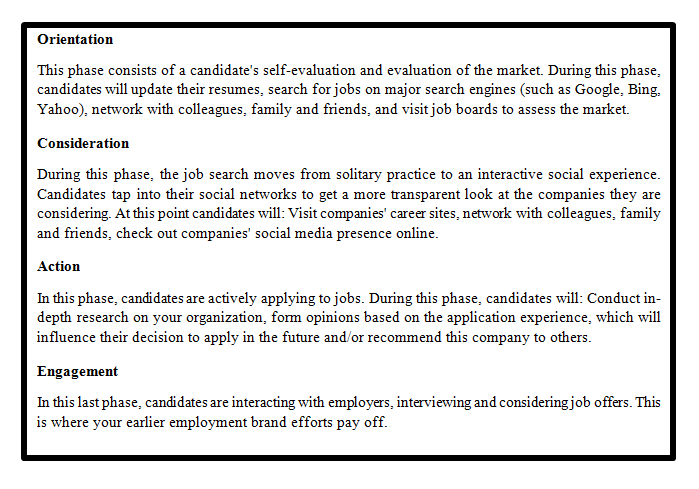
The CareerBuilder study looked at the behavior of candidates throughout the four phases of their job search (orientation, consideration, action, and engagement) and found that the internet and social media were used throughout each of the phases. (See Figure 1 for a definition of each of the four phases.)
Figure 1: The four phases of the the job search
Source: 2013 CareerBuilder Candidate Behavior Study
Job seekers in the orientation and consideration phases have not yet applied for a job at your company. Instead they are assessing the market, learning about an industry, and learning about companies within the industry. These stages are very much knowledge seeking phases for the candidate. Companies who are positioned right can attract great talent during these phases. However, companies who do not have a strong online presence and who do not participate in social media will not catch the eye of job seekers. Think of it as speed dating – you only have a short period of time to make an impression. According to the Neilson Norman Group you have 10 to 20 seconds to make that great impression. If you don’t make a great impression during those few seconds the user will navigate away from your website. Therefore you need to make sure that your website is visually engaging, easy to navigate, and contains quality and informative content.
When a candidate reaches the action stage they not only apply to jobs, they also conduct more in-depth research about a company, and form opinions based on the application experience. Candidates are not afraid to share their experience with the application process. Fifty percent of candidates share bad experiences with others and 64 percent share positive experiences.
In the engagement stage candidates interact with employers, interview for positions, and consider offers. Ninety-one percent of candidates believe employment brand plays a role in their decision whether or not to apply – therefore it is at this stage where your company’s online presence and participation in social media pays off.
How do candidates looking for a position within the manufacturing, transportation, and warehousing industries approach their job search? Let’s look.
Manufacturing industry
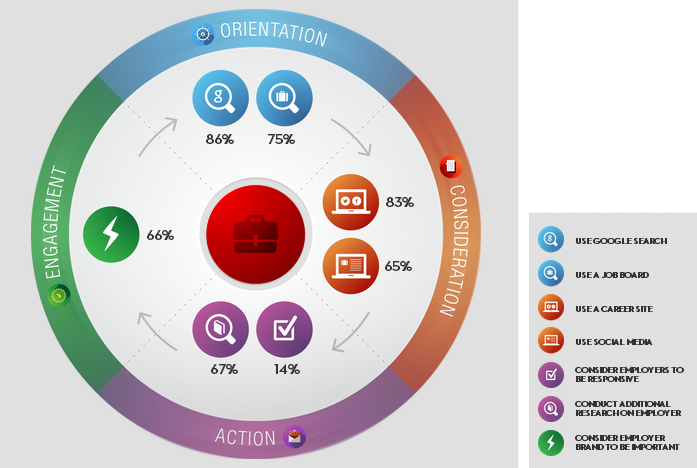
As shown in Figure 2, within the orientation stage, 85 percent of candidates looking for a job within the manufacturing industry turned to Google and 75 used a job board. In the consideration stage 83 percent used a company’s career site and 65 percent used social media to learn more about the company.
In the action stage 67 percent of candidates reported that they conducted additional research on an employer. In this stage only 14 percent of candidates reported employers in the manufacturing industry to be responsive.
Finally, looking at the final stage of the candidate’s journey, 67 percent reported that they felt the employer brand to be important.
Figure 2: The four phases of the job search; manufacturing industry
Source: 2013 CareerBuilder Candidate Behavior Study
Transportation and warehousing industries
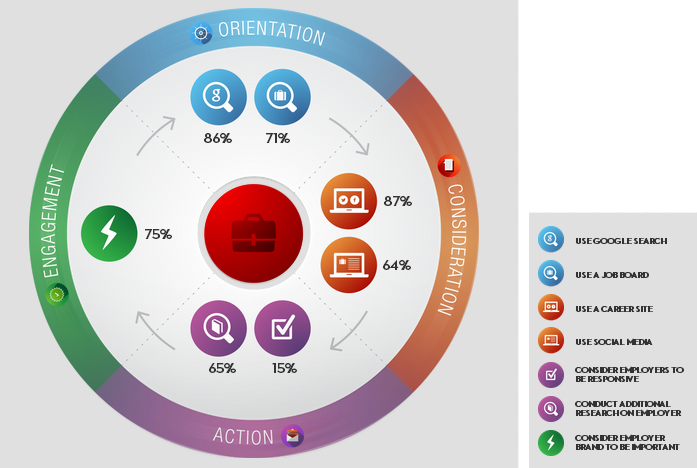
Figure 3 shows that within the orientation stage 86 percent of candidates looking for a job within the transportation and warehousing industries turned to Google and 71 percent used a job board. In the consideration stage 87 percent used a company’s career site and 64 percent used social media to learn more about the company.
In the action stage 65 percent of candidates reported that they conducted additional research on an employer. In this stage only 15 percent of candidates reported employers to be responsive.
In the engagement phase, 75 percent of candidates reported that they felt the employer brand to be important.
Figure 3: The four phases of the job search; manufacturing industry
Source: 2013 CareerBuilder Candidate Behavior Study
In the end
Candidates looking for jobs within the manufacturing, transportation, and warehousing industries are using the internet and social media. They are researching these industries and researching companies within these industries. They are forming opinions, acting on these opinions, and sharing their opinions with others.
If the manufacturing, transportation, and warehousing industries want to attract great talent and retain their interest throughout a candidate’s job search they need to invest in their online presence and become active in social media.